

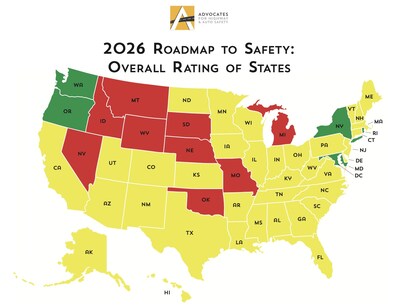
(WASHINGTON, D.C.) - Michigan ranks among the worst states in the nation for traffic safety, earning a red rating in the new 2026 Roadmap to Safety report, while neighboring Indiana and Ohio perform slightly better but still fall short of recommended standards.
The report, released by Advocates for Highway and Auto Safety, grades every state on key traffic laws tied to crash deaths and serious injuries. Michigan is one of nine states nationwide to receive a red rating, indicating it is "dangerously behind" in adopting proven safety measures. Indiana also earns a red rating, while Ohio receives a yellow, or caution, grade.
For residents who regularly live, work, and drive across state lines in Michigan, Indiana, and Ohio, the differences highlight how traffic safety laws can change dramatically from one border to the next.
The report points to several gaps contributing to Michigan's low ranking, including the repeal of the state's universal motorcycle helmet law and the lack of rear seat belt requirements. Advocates also cite weaker teen driving rules and limited use of automated enforcement such as red-light and speed cameras.
Indiana shares many of the same shortcomings. Like Michigan, Indiana lacks a universal motorcycle helmet law and does not require seat belt use for all vehicle occupants. Ohio, while not among the worst-performing states, still falls short of the report's top safety standards and receives a yellow rating, signaling the need for improvement.
Nationwide, the report notes more than 40,000 people die each year in traffic crashes, with millions more injured. Advocates say speeding, impaired driving, distracted driving, red-light running, and failure to wear seat belts remain the leading contributors.
Only five states and Washington, D.C. receive a green rating for meeting most recommended safety measures. No state earns a perfect score.
Safety advocates are urging lawmakers in all three states to strengthen traffic laws in 2026, warning that inconsistent rules across state lines can put drivers at greater risk. Michigan officials point to the state's "SAFER by 2030" initiative, which aims to reduce traffic deaths by 30 percent, but the report says additional legislative action will be necessary to reach that goal.
For drivers in the Indiana-Ohio-Michigan border region, the report serves as a reminder that crossing a state line can mean crossing into a very different traffic safety landscape.